

Google published an official guide on optimizing for generative AI features in Search. If you've been following the SEO world lately, you've seen the acronyms pile up: AEO, GEO, LLMSEO. New vendors, new playbooks, new budget asks.
Google's answer is simple and a little anticlimactic: optimizing for AI search is still SEO. The same index, the same ranking signals, the same content standards that have always applied.
You can read the source guide here: Optimizing your website for generative AI features on Google Search.
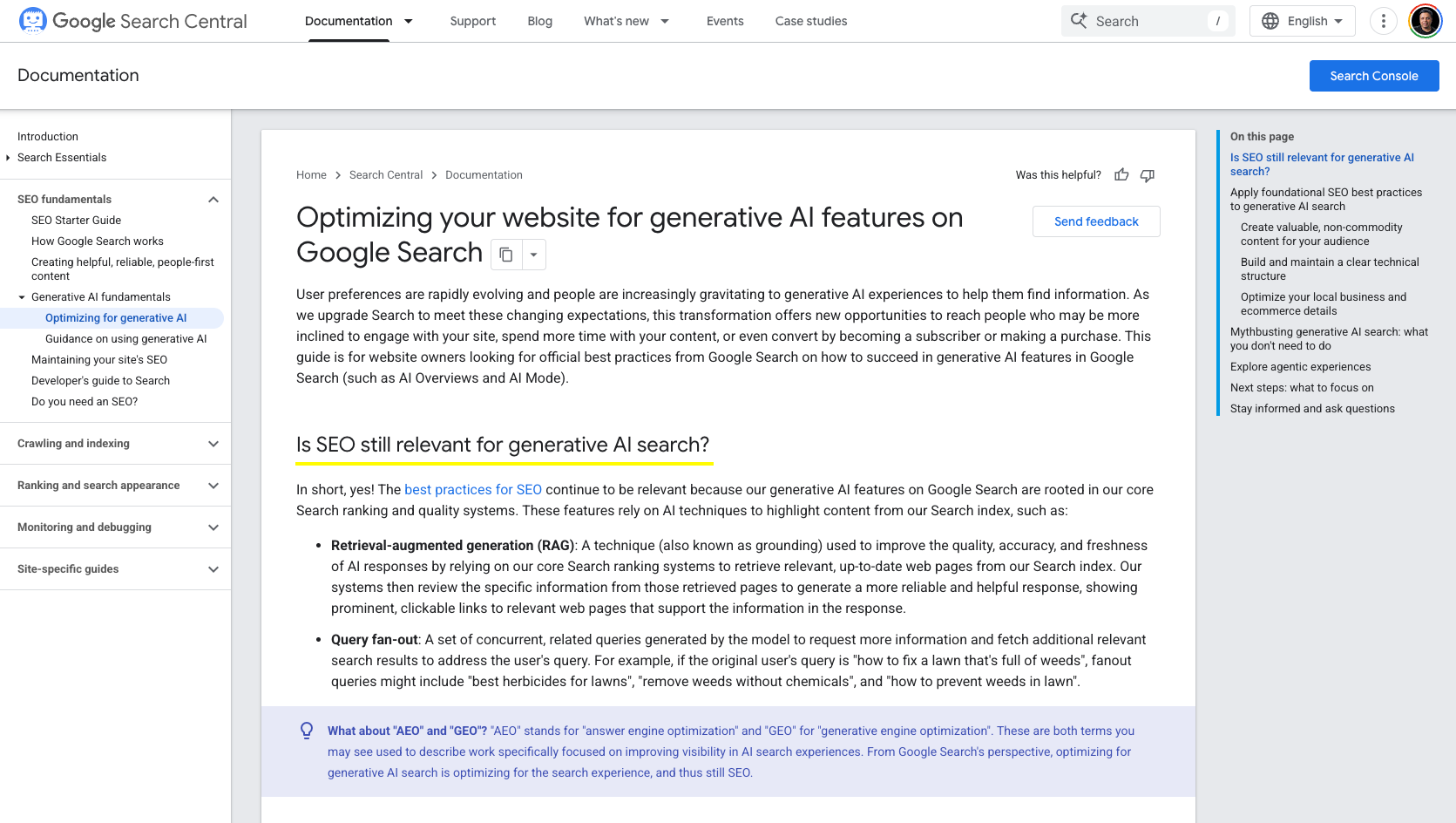
AEO and GEO are still SEO
Google is direct on this. AI Overviews and AI Mode run on top of the same ranking systems that power regular Search.
Two techniques sit underneath the AI response layer:
Retrieval-augmented generation (RAG) : also called grounding. When someone searches, the AI pulls relevant pages from Google’s existing index, builds a response from them, and shows clickable citations back to those pages. The pages it pulls from are the same pages that rank in regular Search.
Query fan-out: The model doesn’t just process the literal query. It generates a set of related sub-queries to gather more context. Google’s own example: “how to fix a lawn full of weeds” fans out into “best herbicides for lawns,” “remove weeds without chemicals,” “how to prevent weeds in lawn.” Each sub-query hits the same index.
Both techniques depend entirely on what’s already indexed and ranked. So if your pages rank in regular Search, they’re eligible to appear in AI features. If they don’t rank, they’re not. There is no separate AI search track to optimise for.
What Google says to focus on
The guide doesn’t introduce anything new. It reframes existing SEO best practices in the context of AI search.
Non-commodity content with a real POV: Google draws a clear line between commodity content and non-commodity content. Commodity is anything that could have been written by anyone: a listicle of generic advice, a summary of what other people have already published, an article that adds nothing to what’s already searchable. Non-commodity is content only you could have written, built on first-hand experience, original data, or a clear perspective that comes from actually doing the work.
Google’s full criteria for what counts as helpful and reliable content are in Creating helpful, reliable, people-first content. That doc has a self-assessment checklist worth running against your content calendar.
Technical basics that let Google find and read your pages: Pages need to be indexable, crawlable, and eligible to show a snippet. The guide points back to the Search Essentials and the SEO Starter Guide for the full requirements. A few things worth checking: if your site is large or updates frequently, review the crawl budget guidance. If you use a JavaScript framework, follow the JavaScript SEO best practices. Duplicate content still wastes crawl budget and creates a poor user experience.
Page experience: Pages should load fast, display well across devices, and make it easy to read the main content without fighting ads or pop-ups. The full guidance is in Understanding page experience.
Images and video: AI features surface relevant images and videos alongside text responses. If you already follow image SEO best practices and video guidance, nothing changes here.
What Google says you can stop worrying about
llms.txt files and other AI-specific markup: There is no special file format or markup that helps Google’s AI features find or prefer your content. Google crawls many file types beyond HTML, but that does not make those files a ranking signal for generative AI.
Chunking your content for AI parsing: You do not need to break pages into small sections for AI to process them. Google’s systems can understand a multi-topic page and surface the relevant part. There is no ideal page length.
Rewriting content in an AI-friendly voice: The systems understand synonyms and intent. A separate AI-optimised version of your content is not needed. This is also covered in the SEO Starter Guide: Google’s language matching connects queries to relevant content without exact keyword overlap.
Chasing inauthentic mentions: AI features do factor in what’s being said about a product across the web. But manufactured mentions through blog networks, forum posts, or paid placements are not the lever they’re sometimes described as. Google’s spam policies are built specifically to catch this.
Special structured data for AI: There is no schema designed for generative AI features. Structured data is still worth using for rich results in regular Search. Details in the structured data overview.
What Google says about agentic experiences
The core idea is simple. Some of your website visitors are no longer human. AI agents are being used to research products, compare options, check pricing, and in some cases complete purchases on behalf of users. These agents do not see your website the way a person does. They work from a machine-readable version of it, built from three inputs: screenshots of the rendered page, the raw HTML structure, and the accessibility tree (a stripped-down map of every interactive element on the page, the same one screen readers use).
What this means practically is that pages designed purely for visual polish can be difficult for agents to parse. A pricing page where the tiers live inside a JavaScript-rendered interactive slider is harder for an agent to read than a pricing page with static text. A CTA button built from a styled div rather than a proper HTML button element may not register as clickable at all.
The web.dev doc makes a point worth noting: everything that makes a site easier for agents also makes it better for human users. This is not a separate technical project. It is accessibility and semantic HTML, which are things most SaaS sites have de-prioritised for years in favour of visual design.
The core message from the guide is uncomfortable in the way honest things usually are. There is no parallel discipline. There is no new playbook.
There is the same work there has always been: useful content, readable pages, real point of view. The pages that show up in AI responses are the pages that were already worth citing.
Yours Promptly,
Manu