

Walk into any B2B marketing war room and the picture rarely changes.
A spreadsheet of dream accounts glows on the wall. Sales leans forward, half-nodding. Marketing scrolls through endless data and dashboards, debating who’s “in market” this quarter.
For the sake of progress, let’s assume everyone’s finally on the same page.
We know the idea works: focus on the right accounts, at the right time, with the right message. What’s changed is the precision.
Tools like Clay now connect the dots between data and timing, turning guesses into repeatable wins. It can bridge your CRM, enrichment layers, and AI systems, pulling signals together and surfacing patterns that used to drown in spreadsheets.
In this letter, we’ll look at how tools like Clay and a bit of AI precision can make ABM work in practice: how to create and enrich target lists, find the champions behind job titles, identify intent signals, personalize outreach and experiences through integrations, and finally, score the accounts that close.
Think of this as an ABM user manual broken into four stages that take you from identifying the right accounts to measuring what actually worked: Identify, Engage, Convert and Measure.
1. Identify (Hint: CRM is your best friend)
Ideally, every ABM play should start in your CRM.
It might look like a cluttered archive of names and numbers, but if you listen closely, it’s full of stories.
The ghosts of closed-lost deals whisper lessons most ignore.
Closed-won deals, meanwhile, help you backtest ICPs.
Series B SaaS companies with 500 employees and a growing RevOps team: that’s a pattern. Startups under 50 employees that keep churning: that’s another one, a warning sign.
Once you’re done playing Sherlock and identifying your target accounts, it’s time to turn those clues into a system.
1a) Building the Target List (finding who’s worth the chase)
Start with what you already know. Your CRM holds the blueprint.
Build a set of existing customer lookalikes (your true target accounts) inside Clay.
Filter by firmographics that actually matter: region, industry, employee size, funding stage, revenue band, and growth rate.
Strip out the noise with exclusion filters: off-region markets and small accounts that might look tempting but will never scale.
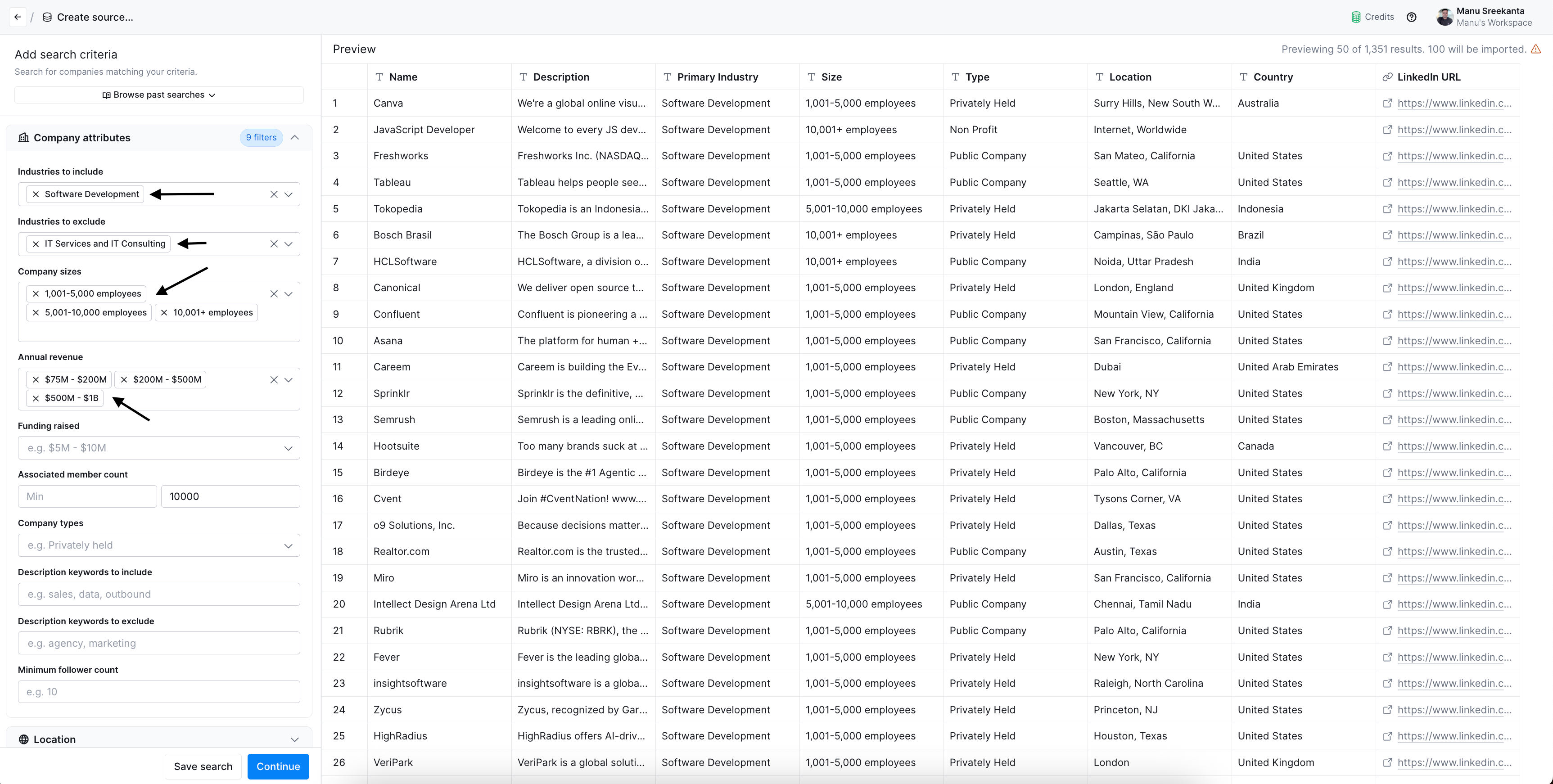
Output: a map of target account opportunities to pursue.
1b) Identifying Signals and layer with intent data (Account Intelligence)
This is where your list starts breathing. Use Clay to layer signals that help you separate companies standing still from those gearing up to buy.
Some of the account signals include:
Hiring surges in GTM, RevOps, or product roles that hint at scaling pain.
Funding events or new investment rounds that indicate fresh budgets.
Job postings revealing priorities: Head of Demand Gen or RevOps Lead
Tech stack data (CRM, HRMS etc.) using Clay’s technographic enrichments.
Geographic expansion or new office locations that signal growth plans.
Compliance milestones such as SOC 2 or ISO certifications that hint at enterprise readiness.
Hiring freezes or layoffs, on the other hand, might indicate accounts to pause on.
Output: a scored sense of why now for each account, not just which accounts.
1c) Champion Hunting (People-level Intelligence)
Responsibilities and skills often reveal more than job titles do.
Use Clay to find the people who will actually move the deal.
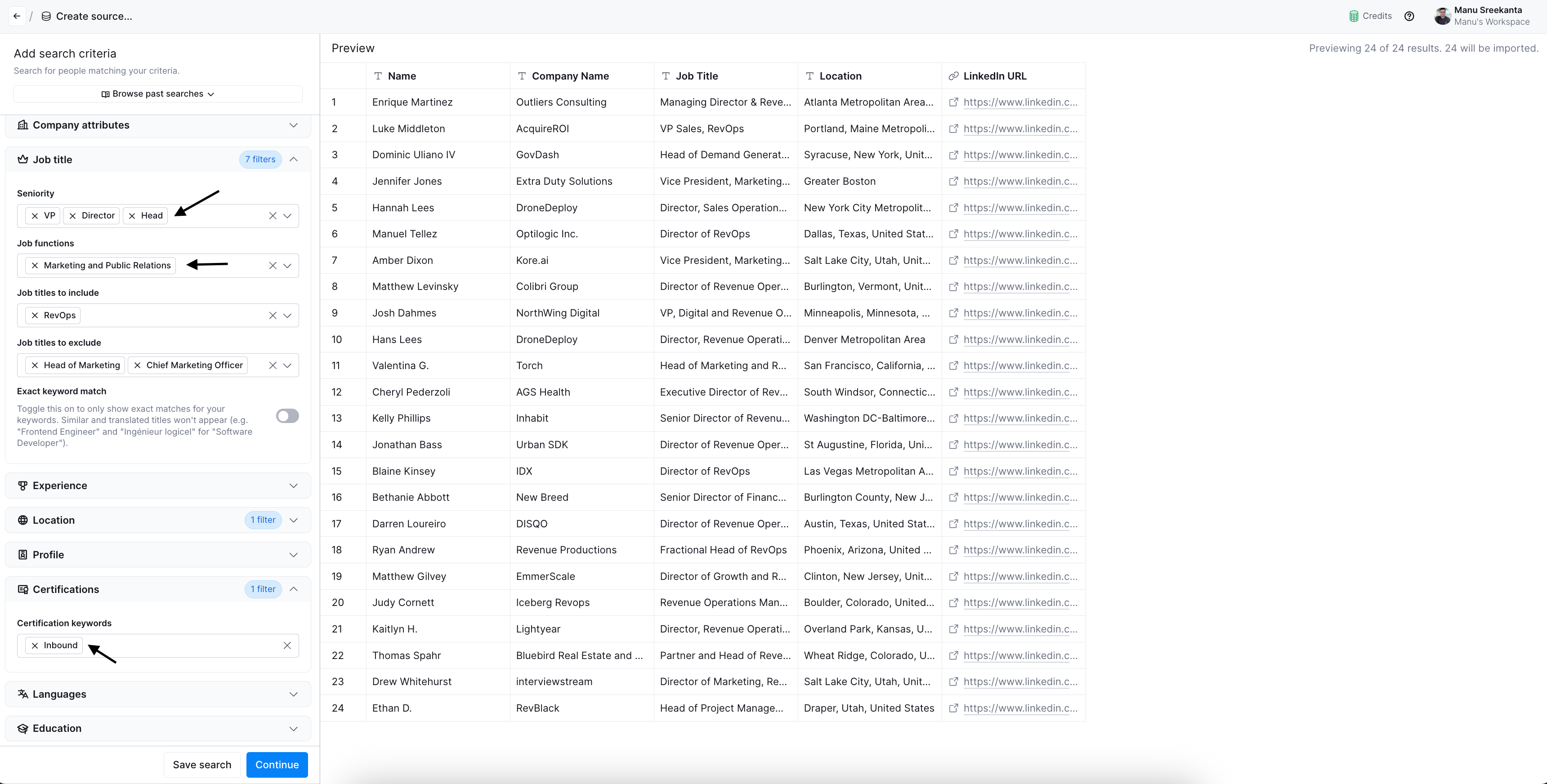
Within Clay, filter people by job title, function, and seniority to identify who fits your buyer persona. Exclude interns, junior staff, non-buyers, or unrelated functions early to avoid cluttering your contact map. The goal is precision, not volume.
Then, layer intelligence across multiple dimensions:
LinkedIn enrichments: search headlines, About sections, experience, and skills for high-intent keywords such as ‘ABM,’ ‘HubSpot,’ ‘RevOps,’ or ‘Pipeline.’ These details help you find the operators behind the strategy, not just the signatories.
Certifications: spot credible professionals like ‘Salesforce Admin,’ ‘Inbound Certified,’ or ‘Marketo Expert.’ These credentials highlight hands-on expertise and influence in key buying decisions.
Past companies: look for professionals who have worked with your competitors or used your product before. Prior exposure often means built-in trust and a shorter sales cycle.
Experience and tenure: track how long they’ve been in their current role and industry. New hires bring change and new tools, while tenured leaders hold institutional control and decision weight.
Education and languages: note relevant degrees, programs, or multilingual skills. These details help tailor outreach and show cultural awareness in international or cross-regional accounts.

Output: Not just names but people annotated with real proof of expertise.

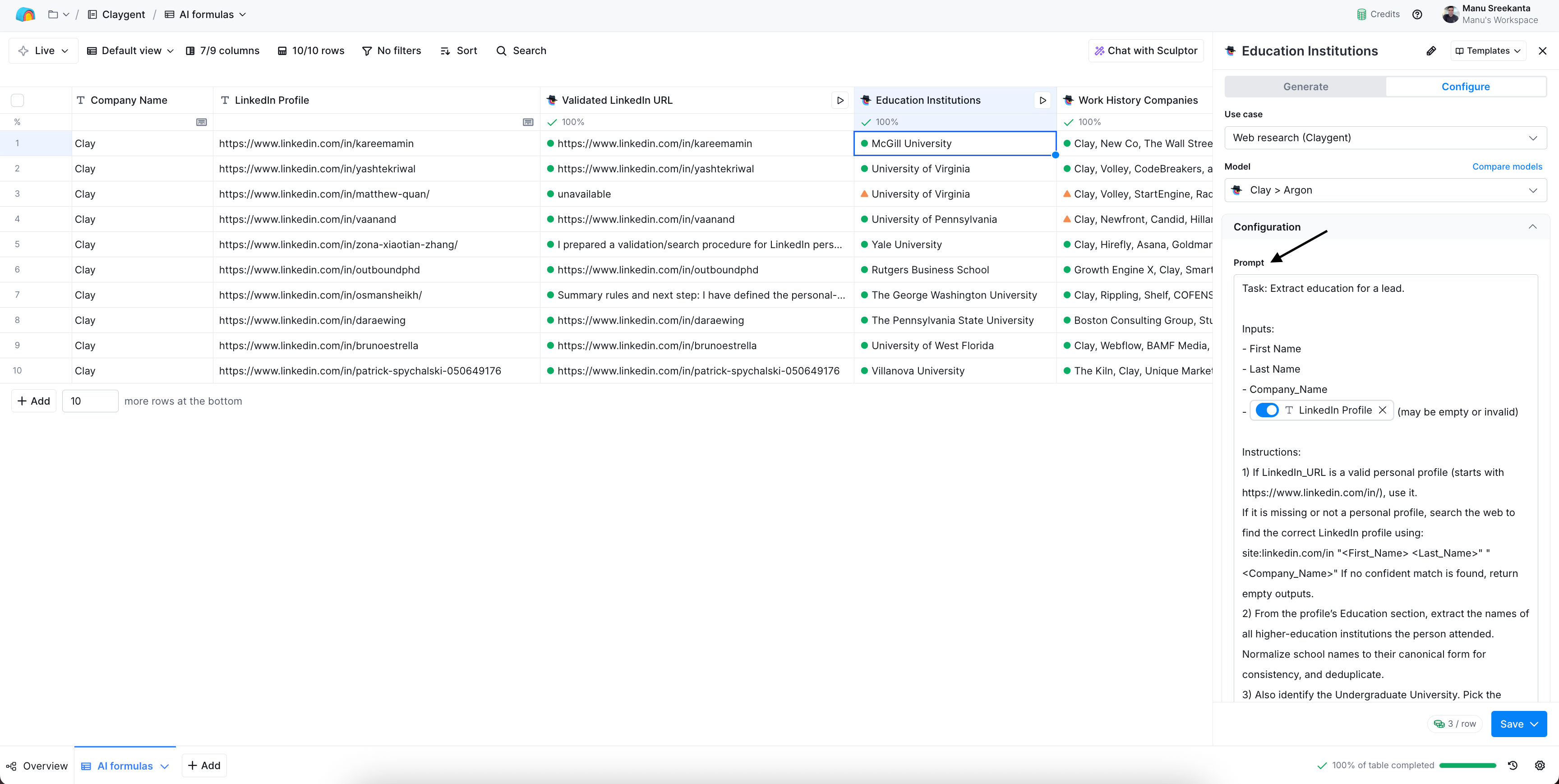
A lot of the heavy lifting can be done with Claygent, Clay’s own web scraper. You can prompt it to find exactly what you need: past companies, universities, cleaned URLs, or even specific keywords hidden in profiles and pages. It’s the easiest way to turn scattered web data into structured, usable context.
1d) Waterfall Enrichment (turn flat rows into full profiles)
Before Clay, enrichment felt like roulette. You copied a list into one tool, waited, copied the leftovers into another, prayed the emails would bounce less than last time, then repeated it all next quarter.
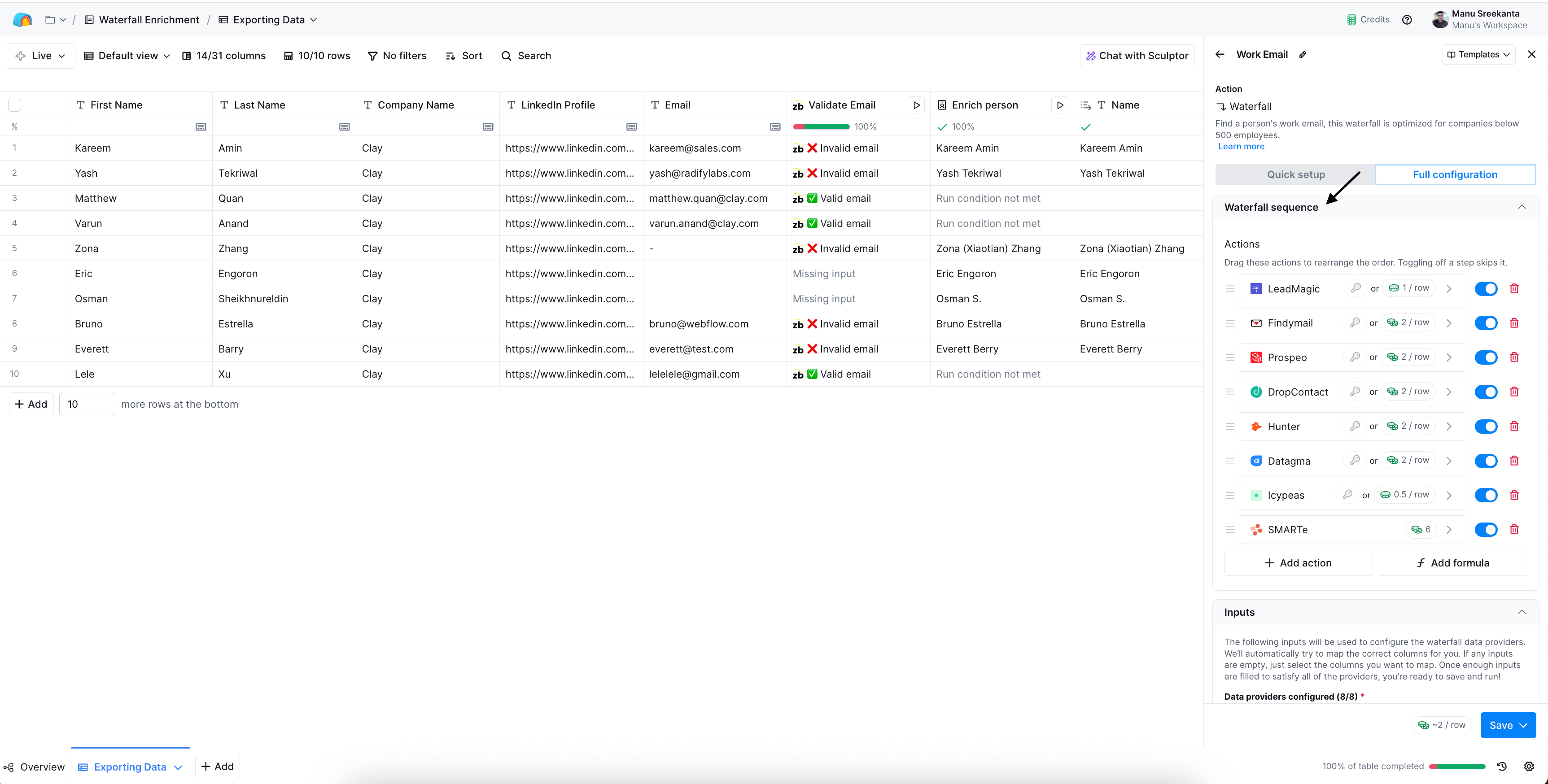
Clay ends that cycle with waterfall enrichment. You set the order, and Clay runs each provider in sequence, validating at every step. If Apollo fails, Clay tries Prospeo. If that misses, it moves to People Data Labs or LeadMagic.
Each layer checks deliverability and flags risky domains before you ever hit send.
The result is cleaner lists, live data, and lower bounce rates when paired with verification tools like ZeroBounce or NeverBounce.
2. Engage (from creepy personalization to relevance)
Everyone talks about being “personal.” Turns out, that’s the part that backfires.
Account-level personalization works.
Talk about their company, their market, their competitors.
Industry-level personalization scales.
Show you understand SaaS, fintech, or healthcare.
Pain-point-level personalization builds trust.
Focus on what keeps them up at night, not what they posted at brunch.
Personal-level personalization? Risky.
That’s not intent. That’s stalking. That’s just being a creep.
The goal isn’t to sound personal. It’s to sound relevant.
2a) Personalized Outreach (Smart, Not Spammy)
Personalization dies when outreach turns into a copy-paste contest. Clay keeps the system grounded by syncing every interaction back to your CRM. Paired with the right tools, it helps your outreach flow across channels without sounding repetitive.
Smartleads.ai: Pull enriched contacts straight from Clay, build custom sequences, and let AI handle timing, warmups, and follow-ups. You can even use Clay prompts to add account- and pain-point-level personalization like referencing a recent funding round or tech migration without typing.
Heyreach: Sync LinkedIn data from Clay, automate profile visits, connection requests, and follow-ups, and turn what looks like automation into intelligent sequencing. Heyreach lets you engage multiple stakeholders from the same account in parallel while keeping each thread personal.
Progressive Climbing: Treat outreach like a ladder
Start with mid-level managers, they respond faster, speak in problems, and often translate value into budget conversations for the decision-makers above them.
Managers are the footholds. Directors are the bridge.
Executives are the summit. Skip a step and you’ll slip.
Multi-Threading Without Chaos
Big accounts come with big committees. That’s where most ABM falls apart.
The CFO gets ROI math.
The CMO hears the growth story.
The VP of Ops sees integration clarity.
The managers get tactical enablement.
Each thread moves in sync. Pure orchestration.
In a Clay x MarketerHire bootcamp video, Bruno Estrella (Head of Marketing at Clay) and David Grieco (Director of Growth at Verkada) showed how you can build an ABM system that creates personalized landing pages and sends direct mail using Clay.
2b) Landing Pages (personalization at scale)
Marketing creates the building blocks: logos, tokens, content snippets, and templates. Sales fills a short form, selecting the use cases or industries they want to highlight.
Clay does the rest. It pulls the right pieces together and generates a live, personalized landing page instantly. (Works best if you’re using Webflow.)
No design queues. No “who’s updating the tagline” debates.
When something changes, like a case study, pricing update, or headline, you edit it once in the master template. Every live page refreshes automatically. Two hundred landing pages fixed before your next coffee.
The result isn’t just speed. It’s consistency adapted to the reader, a rhythm between personalization and precision.
2c) Direct Mail (that doesn’t lose Steam)
Verkada runs one of the sharpest direct mail programs in B2B, but even they hit the two enemies of ABM: friction and fatigue.
Address verification: when a company has twenty offices, finding where your contact actually sits in San Francisco and not at the HQ in Texas can take weeks of manual work.
Time: nothing kills sales momentum like telling a rep it will take six weeks to verify an address before a package can even be shipped.
The fix came from Clay’s waterfall model. It compares a contact’s LinkedIn location with the company’s office list and finds the closest match.
3. Convert (turning alignment into action)
Once you’ve opened doors with the right accounts, the next challenge is keeping the conversation alive, accelerating the deals already in motion, and most importantly, focusing on the ones that truly matter.
3a) Account Scoring and Prioritization: Use Clay to create live account scores and sync them back to your CRM. Clay stacks intent signals, enrichment data, and engagement metrics to tell you which accounts deserve dinner and which ones deserves an email. You can score them based on ICP fitment, signals like pricing page visits, email engagement, and more.
3b) Relationship Mapping (Clay × The Swarm): Find warm introduction paths to a target company or person. Leverage your employee, founder, and investor networks to surface who in your extended circle can open the door. Then route the outreach through those warm connections instead of cold requests that vanish into inboxes.
3c) Job Change (New Roles, New Priorities): Use Clay to track who in your target accounts has recently joined, moved, or been promoted. A new hire often means two things: they’re setting fresh priorities, and their previous company might already be your customer, giving you instant credibility.
3d) Competitive Positioning: Clay helps uncover what tools your target accounts are already using, especially for common categories like CRM, HRMS, or analytics. Use that data to craft messages such as “We know you’re on Competitor X. Here’s how we’re different.”
What gets measured gets budget
It isn’t about more dashboards or prettier reports.
It’s about knowing which moves actually mattered.
Once the plays are in motion, the question shifts from “what did we send?” to “what actually moved?”
In the Identify stage, measure reach and relevance. How many of your target accounts were activated, and how many truly fit your ICP? Track contact coverage inside each account. Too few means limited influence, too many without traction means misalignment. Use Clay signals to score accounts and help SDRs focus on the ones that show real intent.
In the Engage stage, measure momentum. Which accounts are opening emails, responding on LinkedIn, clicking through landing pages, or visiting your site? Every touch tells you how close an account is to buying readiness, the difference between curiosity and intent.
In the Convert stage, measure motion. Track how quickly engaged accounts move to pipeline, how much of that pipeline comes from your target list, and how those deals perform over time. Look at deal velocity, average deal size, and conversion rate by account tier. The story isn’t in the number of opportunities created but in how efficiently they turn into revenue.
When alignment meets evidence, budgets find their way home.
The Last Word
Some accounts will turn into deals (dream accounts come true).
Some will ghost you.
And some will ask you to ‘circle back next quarter.’
At the end of the day, the tools can surface patterns and stack signals
But the real skill is still awareness.
It’s knowing which accounts to chase, which ones to drop, and when to stop over-personalizing an email based on their cat’s name
Because great ABM is automation with intuition.
So stay hydrated. Stay caffeinated.
Yours Promptly,
Manu